EN
EN

News
Surface-Activated Calcium Carbonate: Bridging High Filler Loading and Mechanical Toughness in Advanced Polymer Compounding by hezhensy industrial
Overcoming the Dispersion Bottleneck in Plastic Compounding
 formulators face an ongoing compromise: increasing mineral filler loading to reduce compound costs often leads to severe penalties in mechanical performance. Unmodified mineral particles tend to agglomerate, causing brittle fracture, surface roughness, increased melt viscosity, and excessive wear on extrusion screws.
hezhensy industrial surface-activated calcium carbonate () is engineered to resolve this fundamental challenge. Utilizing precision mechanical grinding/precipitation and high-efficiency chemical surface modification (incorporating stearic acid, advanced organo-silanes, or specialized coupling agents), our activated grades convert the naturally hydrophilic mineral surface into an organophilic, polymer-compatible interface.
By optimizing interfacial bonding between the inorganic mineral core and the organic polymer matrix, hezhensy industrial enables masterbatch producers, pipe extruders, and compounders to achieve higher mineral loadings while preserving—and frequently enhancing—impact strength, melt processability, and surface finish.
Interfacial Engineering: The Mechanism of Surface Activation
Natural calcium carbonate possesses high surface energy and polar hydrophilic characteristics, which naturally repel non-polar or low-polarity polymer resins such as polyethylene (PE), polypropylene (PP), and polyvinyl chloride (PVC).
Our precision activation process establishes a uniform, chemical monolayer across each microscopic particle:
- Chemical Chemisorption & Shielding: The polar head of the modifier anchors firmly onto the crystal lattice, while the lipophilic organic tail extends outward into the polymer melt.
- Complete Hydrophobic Conversion: Reduces the particle's free surface energy, achieving an activation rate exceeding (floating rate in water), virtually eliminating moisture re-absorption during ocean transit and processing.
- Optimized Wetting & Shear Dispersion: Under compounding shear forces, modified particles de-agglomerate effortlessly, dispersing as primary particles rather than micro-clusters within the resin matrix.
Key Performance Upgrades in Polymer Processing
Incorporating hezhensy industrial activated calcium carbonate delivers measurable improvements across compound manufacturing and final part performance:
1. Enhanced Toughness and Impact Resistance
In rigid thermoplastics, agglomerated mineral particles act as stress concentrators where micro-cracks originate. In contrast, well-dispersed, surface-coated particles act as stress-transfer nodes. Under mechanical impact, they induce matrix shear yielding and micro-void cavitation around the particles, absorbing kinetic energy and preventing catastrophic crack propagation.
2. Reduced Plasticizer & Resin Absorption
Uncoated mineral powders often absorb significant amounts of liquid additives, plasticizers, and processing aids due to unshielded porous structures. Our surface coating seals micro-pores, reducing the effective oil absorption value (). This preserves effective plasticizer levels in flexible compounds, prevents formulation dry-out, and stabilizes compound rheology.
3. Lower Melt Viscosity & Extrusion Energy Savings
The organic surface layer acts as an internal lubricant during compounding. It lowers melt torque, reduces internal friction against barrel and screw walls, and facilitates higher extruder throughput rates at lower processing temperatures, minimizing thermal degradation of sensitive polymers.
4. Dimensional Stability & Isotropic Shrinkage Control
Injected and extruded plastic parts often experience anisotropic thermal shrinkage and post-molding warpage. Fine, uniformly distributed activated restricts polymer chain mobility during cooling, providing tight dimensional tolerances, reduced mold shrinkage, and superior resistance to heat distortion (HDT).
Tailored Solutions Across Key Plastic Applications
hezhensy industrial customizes particle size distributions, core crystal structures (GCC vs. PCC), and modifier formulations to match specific polymer chemistry:
Technical Specifications and Quality Control Metrics
To guarantee flawless integration on high-speed extrusion and injection lines, hezhensy industrial adheres to stringent quality parameters on every production batch:
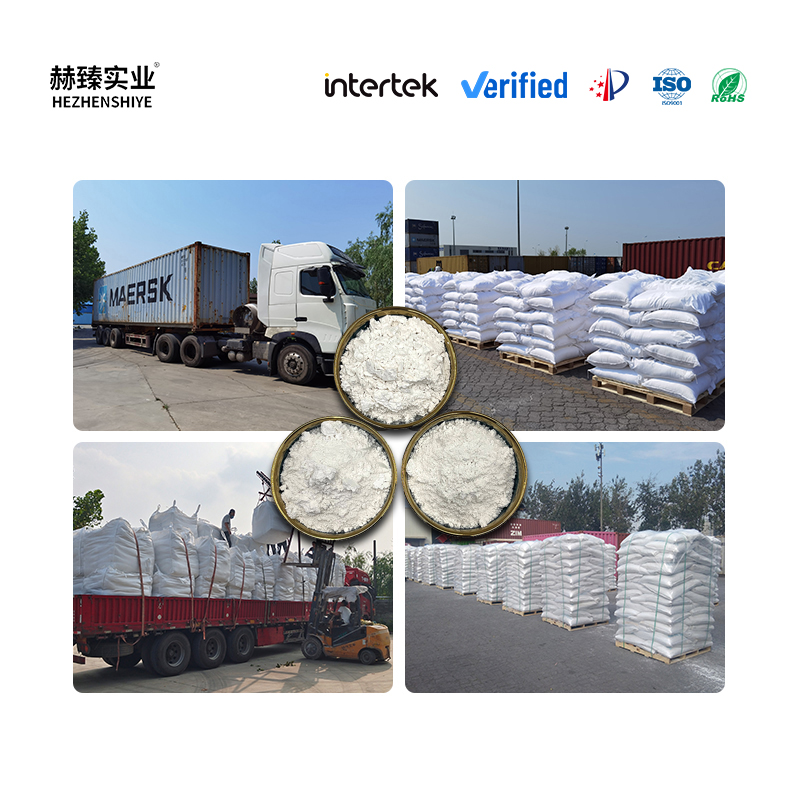 Why Partner with hezhensy industrial?
As global compounders face escalating raw material costs and demanding environmental mandates, choosing a reliable mineral modifier supplier is essential:
- Proprietary Continuous Modification Technology: High-shear, temperature-controlled coating systems ensure particle encapsulation without unbound modifier residue.
- Strict Multi-Stage Iron & Grit Removal: High-gradient magnetic separators eliminate metallic contaminants, protecting processing molds and extrusion dies.
- Comprehensive Compliance & Documentation: Certified under ISO 9001 frameworks; fully compliant with EU REACH, RoHS, and heavy metal restriction limits. Batch-specific Certificates of Analysis (COA) and Technical Data Sheets (TDS) accompany every shipment.
- Formulation & Dispersion Support: Our technical service team provides customized grade matching, assisting compounders in optimizing screw configurations, loading ratios, and dispersion protocols.