EN
EN

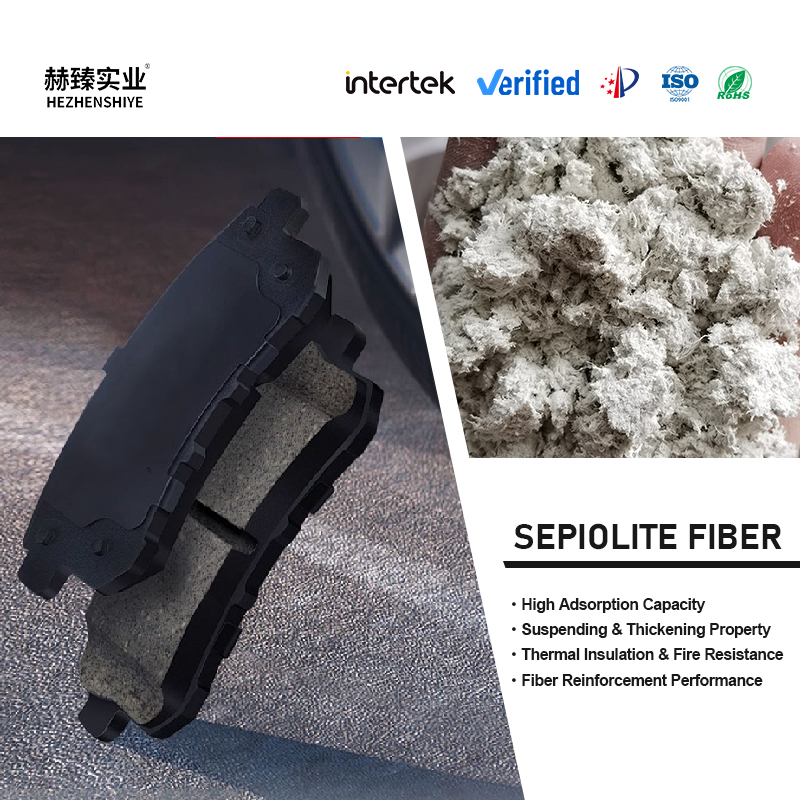
It’s not surprising why sepiolite fiber enjoys a great deal of reputation as a high-performance rheology modifier in numerous industries around the world. A natural hydrous magnesium silicate with an exceptionally fine fibrous structure, it can be used in many products and processes to alter flow behavior, improve suspension and increase viscosity and stability. Here at Hebei Hezhen Industrial Co., Ltd. we have made it our mission to become a reputable supplier of sepiolite fiber so as to allow formulators around the world to achieve more efficient results with their products. We discuss how the natural material acts as a rheology modifier in four key areas.
Unique One-Dimensional Fibrous Structure
The origins of the rheology of sepiolite stem from its unusual one-dimensional nanofiber structure. A layer, which can be used to characterize the basic structural unit of the mineral, consists of stacked, parallel-oriented tetrahedral sheets (SiO4) linked in a zigzag manner by octahedrally coordinated magnesium atoms. Individual fibers typically range from 0.2 μm to 2 μm in length, 100 nm to 300 nm in width, and 50 nm to 100 nm in thickness.
These large aspect ratios—much greater in length than width generate a large surface area, which favors considerable fiber-fiber interaction in the liquid. Due to the strong fiber to fiber interactions and van der Waals forces, the naturally elongated sepiolite particles have the ability to aggregate into bundles, but, when well dispersed in a polar liquid, can build up an extremely efficient and strongly reinforcing gel network which traps the liquid molecules. Due to Hebei Hezhen’s efficient milling and processing procedures, sepiolite is available in high quality and consistency.
Network Formation and Thixotropic Behavior
When dispersed in polar liquids such as water, the sepiolite fibers arrange themselves into a gel network that considerably increases the viscosity of the system. The network is formed by the random alignment of the elongated rigid fibers linked by van der waals forces and ionic attractions at the fiber ends. The combined effect of attractive and repulsive forces in this colloidal suspension creates a thixotropic behavior—the system becomes fluid upon application of mechanical energy (shearing or stirring) and progressively recovers its viscous structure at rest. Sepiolite gels composed of a few percent of solids can exhibit a prolonged “aging” effect, showing a steady increase of the yield stress over weeks.
This makes the fiber suitable for formulating suspension systems like paints and coatings or drilling fluids where it ensures good sag resistance and prevents settlement.
Rheology Control Across Different Solvent Systems
Sepiolite fiber as a rheology modifier isn’t only applicable to aqueous systems but also effective to many kinds of organic systems. Thanks to its hydrophilic surface charge and structure, sepiolite easily gets well dispersed and forms a viscous gel at an extremely low usage amount. Sepiolite gel properties depend on various factors like pH, ionic strength, other additives in formulation, and can vary significantly as a function of these. Yield stress generally increases with solids loading and at higher temperatures, however, a plateau effect might occur at high solids percentage. In the oil-based formulations, sepiolite must be organically modified in order to disperse in the non-polar environment. For example, organically modified sepiolite (organo-sepiolite) shows better rheological properties after aging at 180°C for 16 hours than the untreated sepiolite. Studies suggest that sepiolite’s stability under elevated temperature and salty environment can benefit oil-based drilling applications as well.
Practical Applications and Industry Benefits
The rheological benefits offered by sepiolite fibers can be realized in many different industries. For instance, it can improve cuttings removal and wellbore pressure control in oil and gas exploration. Drilling fluids in deep drilling wells will benefit from the temperature stability and resistance to salinity. Sepiolite fiber can be as thickeners and suspending agents in cement mortars, cement grouts, fire retardant coatings—Hebei Hezhen produces it separately as well, paints, coatings, friction materials, polymer composite materials etc. At Hebei Hezhen Industrial Co., Ltd., we ensure high-quality and competitive prices for all our products due to our ISO9001:2000 certified manufacturing processes, well experienced R&D team (more than 60 professionals), production plants, testing laboratories, warehousing and logistics network and integrated sales service.
Conclusion
To summarize, sepiolite fiber shows a good performance of controlling the properties of fluids by controlling viscosity of both aqueous and non-aqueous solutions, stabilizing suspensions and providing optimal thixotropic effect, which attributes to its special physical and chemical characteristics. If you’re looking for a powerful rheology additive for drilling mud, thickening agents for construction industry, anti-settling agents for coatings, reinforcement fillers for plastic compounds etc, Hebei Hezhen Industrial Co., Ltd. can provide the ideal solution with top grade sepiolite fiber.